
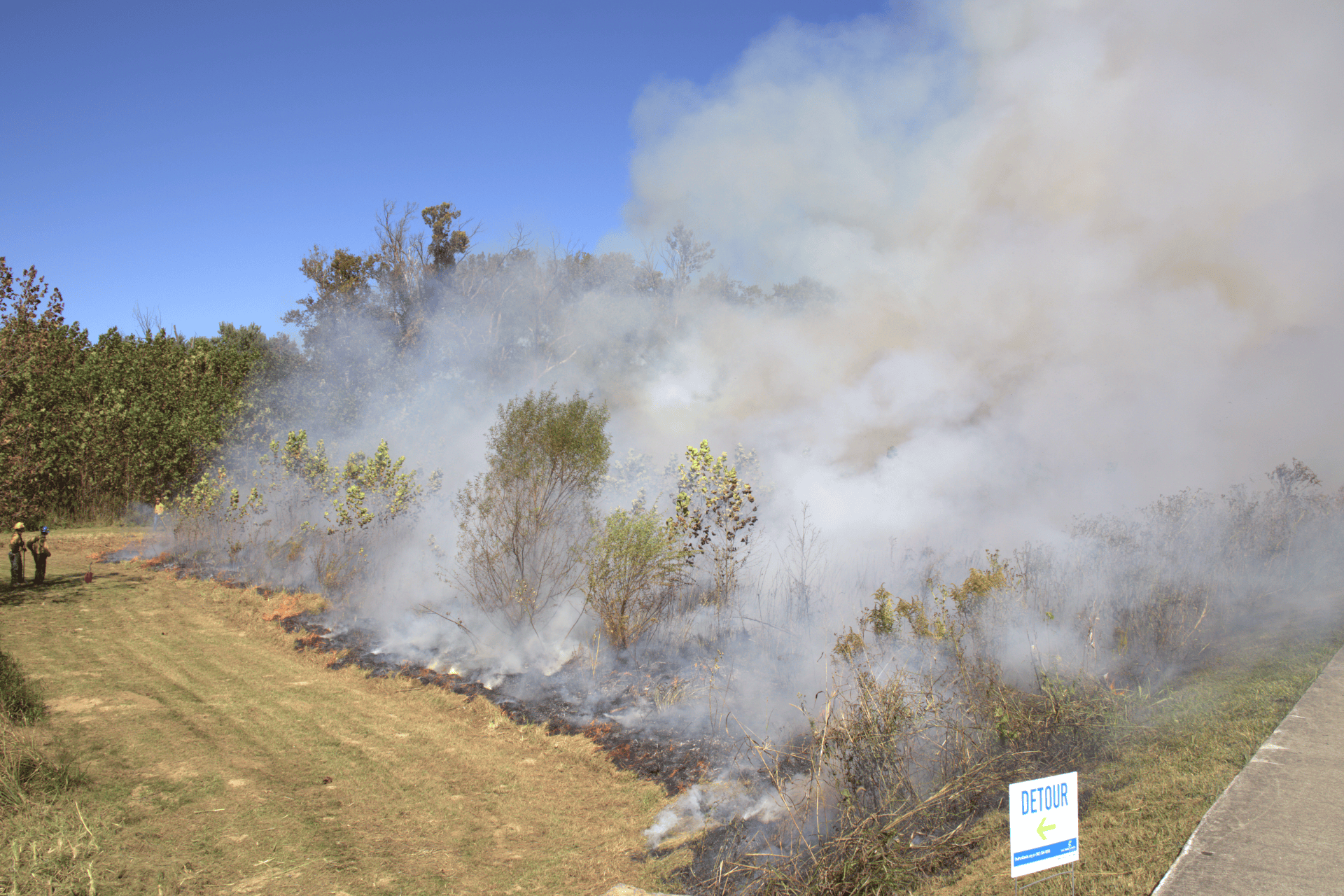
A follow-up discussion on the recent prescribed fire in Seaton Valley
Turkey Run Park
In early October, The Parklands completed a prescribed fire on two neighboring meadow tracts in Seaton Valley, spanning 14 acres. This marked the first time in more than a decade that The Parklands had carried out a prescribed burn.
A prescribed fire, also known as a controlled burn, is much more than lighting a match in a field. In fact, it’s quite different. Every prescribed fire requires extensive training, planning, and preparation.
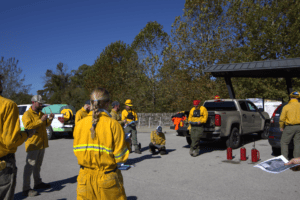
Burn crew members attending a briefing led by the burn boss to go over roles and any important information before the burn
A critical first step in learning how to conduct a controlled burn is understanding fire. The same holds true when working with other elements of nature.
I’m reminded of a lesson I learned from a teacher years ago, when I was taking classes to become a paddling instructor. She always described water as having personality; some give you a lot of feedback, others not much at all, but all features of water encounter factors that influence their behavior, and learning to read them is key.
If you learn to paddle or drive a boat, you must learn how water behaves.
If you learn to fly a plane or a kite, you must learn how air behaves.
Similarly, if you learn to conduct controlled burns, you must learn how fire behaves.
If you work with these elements, you also need to understand their personality so you can predict how they will act.
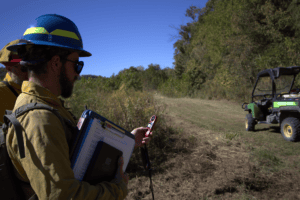
Burn Boss, Evan Cross, checking weather readings before proceeding with the burn
Someone on our team who really gets this idea is Evan Cross, our Assistant Director of Horticulture, Natural Areas, and Trails. He is also a certified burn boss —which isn’t just an objectively cool title.
A certified burn boss is a qualified professional who completes hours of training and coursework before moving on to an extensive apprenticeship and eventually leading a burn. The burn boss drafts the burn plan, makes key decisions, directs the crew, and has many other responsibilities. Even with this oversight, it takes a full team to conduct a burn.
Our burn team was made up almost entirely of our own Horticulture and Natural Areas staff members. To join the burn team, members had to complete hours of training and earn certification from the Kentucky Prescribed Fire Council.
For our team and any burn team, the groundwork for any prescribed fire must be laid years in advance, long before anyone steps into a yellow, fire-resistant jumpsuit.
After learning comes preparation. Fire needs three core elements to burn:
- Oxygen, which is why water or a blanket can suppress a fire
- Ignition—an initial heat source that raises the fuel to its ignition temperature, such as a spark, match, or lightning
- Fuel—materials that burn, such as wood, paper, plant material, or gas

To prepare for a burn, you must make sure these elements are present where you want them and absent where you don’t.
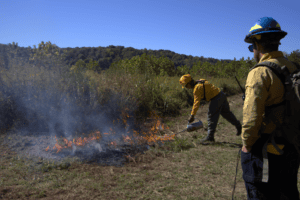
Crew conducts test burn in unit to ensure the fire is behaving the way they want it to
Take fuel, for example. Before a burn, crews must establish firebreaks—areas where fire doesn’t move to because there is no fuel to feed it. Natural firebreaks include lakes, creeks, and rock formations. Man-made ones include roads, paved trails, or wide, mown strips of land, such as utility corridors.
Firebreaks are established around each unit being burned, along with secondary contingency firebreaks. Next, crews decide which fuel to burn. They make multiple passes through the burn unit to ensure the fuel present is suitable.
Just when the crew is set to proceed, they have to play a game of poker with the weather—you need to hit a perfect Goldilocks zone, wait for the atmosphere to reach the right humidity, watch the winds, and consider recent weather-related events like rainfall, among other things. Then, there’s coordinating with neighbors, local agencies, and partner programs.
It’s all pieces of a puzzle that must be perfectly synced to achieve a successful burn.
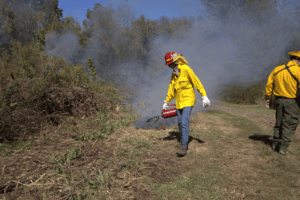
Crew begins burn on first unit
It’s surprising how much work goes into a controlled burn before anyone even ignites a single spark in the field. Although all that work paid off for our team in a successful burn, the work isn’t over yet. So, I sat down with Evan Cross and Tyler Hampton, Director of Horticulture, Natural Areas, and Trails, to discuss this significant step in The Parklands’ history and what comes next.
Q: What were the primary goals of the burn?
A: Roundstone Native Seed LLC had installed a native meadow in Seaton Valley around ten years ago. However, woody species like trees and shrubs were slowly encroaching on the meadow. Managing the woody species in the area, as we had been doing, became increasingly intensive and resource-heavy over time. So, the primary goal was to suppress woody encroachment more efficiently so the meadow could shine through again.
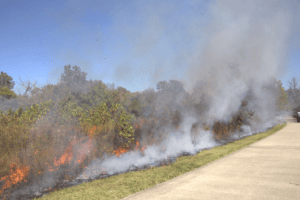
During mid-burn of first unit
Another goal of the burn was to remove years of thatch. Thatch is a dense layer of living and dead plant material between the green vegetation and the soil. The problem is that when this layer gets too thick, it forms a barrier that blocks sunlight, nutrients, and air from reaching the soil, preventing self-seeding native plants from germinating.
Q: Were we successful in meeting our goals?
A: Yes! The execution of the burn went according to plan, and we have observed a high mortality rate among woody species since the burn. Timing a burn is always a major challenge. A burn was planned for last year, but the weather wasn’t favorable, so we had to pass on the opportunity. This year, we were able to capitalize on a window of weather conditions that were very conducive to burning.
Q: Was the timing of the burn intentional?
A: Yes, in the fall, woody species of trees and shrubs, along with other dominant perennials, are still growing. They are actively moving sugars to their root systems to store energy and prepare for winter. Burning these plants now takes advantage of this vulnerable time and is one of the most effective ways to ensure long-term mortality among woody species.
Another reason to burn in fall is that these plants will experience further stress from being unable to recover before winter hits, leaving them even more susceptible.
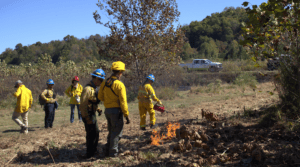
Crew begins burn on second unit
There is a saying in the prescribed fire community: “Fall fires promote forbs.” Forbs are non-woody, flowering plants―think a meadow of wildflowers. These plants thrive after a burn when spring comes around, taking advantage of bare ground and reduced competition to germinate and grow.
Many people expected the burned areas to look like Mars, with the fire reducing everything to ash. But these are low- to moderate-intensity fires that move slowly through the landscape.
The plants our controlled burns encounter aren’t like the fuel in the extreme wildfires shown on the news. Most of these plants are still growing and full of water, so the fire doesn’t get as hot or burn for as long.
The goal isn’t to torch everything down to bare land, but to expose targeted plants to environmental stressors that lead to eventual mortality.
Q: What does the follow-up look like after the burn?
A: A few weeks after the burn, we went back and mowed the units. This isn’t always necessary, but it adds another stressor for the targeted species. In June or July, we may mow or introduce another type of disturbance, again, if many woody species are still present. These efforts help establish a baseline; once we have a good baseline, maintenance will be less frequent as the area becomes more self-sufficient.
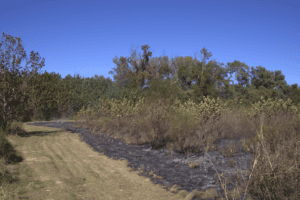
Shortly after burn on first unit
When you remove invasive and woody species, you want to make sure they’re replaced by plants you want. We’ll monitor the area and fill any gaps with native species if they don’t grow in naturally. This will prevent other invasive species from taking advantage of the available space.
Monitoring the area is a large part of our follow-up plans. We’re looking for changes in grassland plant diversity and a reduction in woody plants, as well as broader ecological changes in both flora and fauna. We saw almost immediate impacts: flycatchers and other insect-eating birds flocked to the area to feed on newly exposed insects, which was fun to watch.